The UAE’s New Civil Transactions Law: A Recodification of Private and Commercial Law
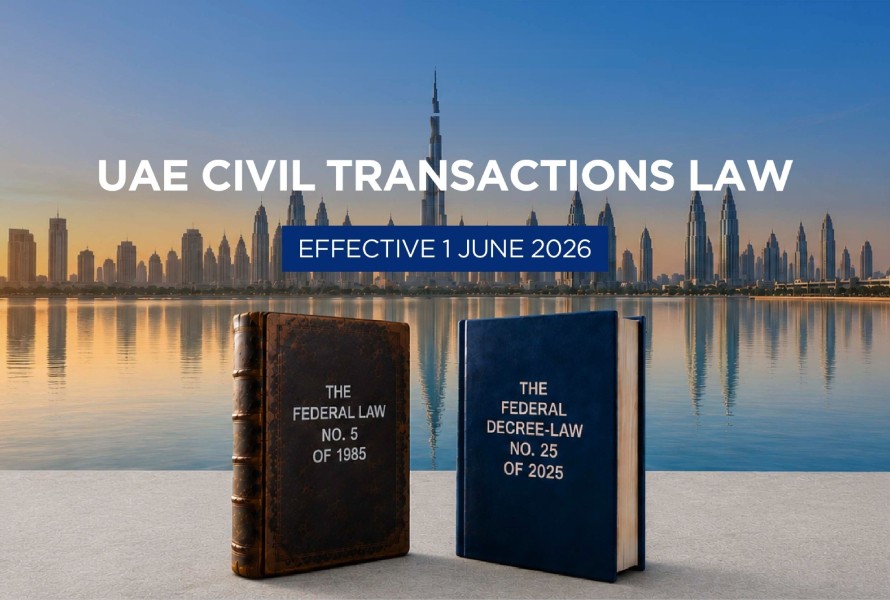
On 30 December 2025, the United Arab Emirates issued Federal Decree-Law No. 25 of 2025 on the Civil Transactions Law, which repeals and replaces Federal Law No. 5 of 1985 — the framework that had governed civil and contractual relations in the country for four decades. The new Code entered into force on 1 June 2026.
The reform is best understood as a comprehensive recodification rather than a break with the past: it preserves the core structure and Sharia-based foundations of the 1985 Law while modernising drafting, introducing new obligations, and aligning the UAE with contemporary international standards. For businesses, investors, and individuals, the practical effect is a clearer and more predictable framework governing contracts, civil liability, property, capacity, and cross-border dealings.
The most significant changes are outlined below.
Reduced age of majority
The age of full legal capacity is lowered from 21 Hijri (lunar) years to 18 Gregorian years. Beyond the numerical reduction, the amendment unifies the reference system and harmonises the civil capacity threshold with the UAE’s labour, juvenile, and criminal-responsibility regimes. In practice, this strengthens the enforceability of contracts concluded with 18-to-20-year-olds and reduces capacity- based challenges. In parallel, a minor may now apply for judicial authorisation to manage personal or inherited assets from the age of 15 (previously 18 Hijri years), subject to court approval — a measure intended to support youth entrepreneurship under judicial oversight.
Pre-contractual good faith and disclosure
The Code codifies a duty of good faith in the negotiation phase, including an obligation to disclose fundamental information so that the counterparty can make an informed decision. Liability may now arise where negotiations are conducted or terminated in bad faith — for example, where material and decisive information is deliberately withheld. This elevates the standard expected during deal-making and creates exposure before a contract is formally signed.
Enhanced protection for buyers
The provisions on sale contracts — particularly relevant to real estate and goods — have been clarified and strengthened. Where a latent (hidden) defect arises, the buyer is no longer confined to the binary choice of rescission or acceptance at the full price; the buyer may now reject the goods, retain them against a proportionate price reduction, or demand a defect-free replacement (Articles 493–495). The limitation period for latent-defect claims is extended from six months to one year from delivery, unless a longer contractual warranty has been agreed. Additional safeguards apply to sales by sample or model, and to transactions involving persons of limited legal capacity (notably grossly undervalued real estate sales).
Corporate and contractual modernisation
The Code draws a clearer distinction between civil and commercial companies by reference to activity and legal form, expressly recognises single-person companies, and sets out more detailed rules on partner withdrawal, business continuity, and liquidation. On the contractual side, it introduces the concept of the “framework agreement” — a mechanism that pre-defines essential terms to govern recurring or long-term relationships efficiently, reducing cost and providing a consistent legal reference for subsequent contracts.
Refined civil liability and abuse of rights
The doctrine of abuse of rights is given a clearer, more structured test (Article 106) for assessing when the exercise of a legal or contractual right becomes unlawful. The civil-liability regime is modernised more broadly, including recognition of the duty to mitigate and the ability of courts to award additional damages alongside blood money (diya) where material or moral harm is not fully compensated by diya alone.
Private international law
The conflict-of-laws and jurisdictional rules are updated to prioritise party autonomy: contractual obligations are governed by the law expressly chosen by the parties, with default rules (common domicile, then place of performance) applying only in the absence of agreement (Article 19). This reduces the scope for jurisdictional disputes and improves certainty for cross-border and multinational transactions with a UAE element.
Judicial assistance and protection of will
A new judicial assistance mechanism allows the courts to appoint an assistant for individuals who are unable to express their will, supporting them in acts that serve their best interests — extending protection while still enabling supervised participation in legal transactions.
Practical takeaways
- Onshore application. The new Code governs transactions under onshore UAE law. The financial free zones — the DIFC and ADGM — retain their own common-law-based civil and contractual regimes, so governing law, jurisdiction, and enforcement routes must be selected and differentiated with care.
- Contract drafting. The heightened good-faith and disclosure duties, refined remedies, and clearer limitation periods raise the standard expected of onshore contracts. Negotiation conduct, disclosure protocols, governing-law clauses, and warranty periods all warrant review.
- Estate and succession planning. Where a foreigner with assets in the UAE dies leaving no heirs, those assets may be treated as a charitable endowment (waqf) under official supervision — a point expatriate clients should factor into their planning.
- Transitional matters. The Code applies prospectively, with limitation periods forming an exception to non-retroactivity; arrangements straddling 1 June 2026 should be assessed individually.
This article is provided for general information only and does not constitute legal advice. For tailored
guidance on how the new Civil Transactions Law affects your contracts, corporate structures, or cross-
border transactions, please contact our team.